
ETn Hub – www.energytransitionnet.com
Introduction: The Carbon Ledger in the Boardroom
In the age of climate accountability, the language of emissions has become as familiar to energy leaders as the language of finance. Boardrooms that once pored over balance sheets now scrutinize carbon ledgers, and the terms “Scope 1” and “Scope 2” have become shorthand for a company’s climate impact and its credibility in the eyes of investors, regulators, and the public. Yet, beneath these seemingly simple categories lies a world of complexity, strategy, and risk. For energy leaders, understanding the nuances between Scope 1 and Scope 2 emissions is not just a matter of compliance—it is a strategic imperative that shapes investment, operations, and reputation.
This journal unpacks the definitions, differences, and real-world implications of Scope 1 and Scope 2 emissions, drawing on case studies, regulatory trends, and best practices. It is a guide for energy executives navigating the evolving landscape of carbon management, where the stakes are as high as the planet’s future.
The Fundamentals: What Are Scope 1 and Scope 2 Emissions?
Scope 1: The Emissions You Own
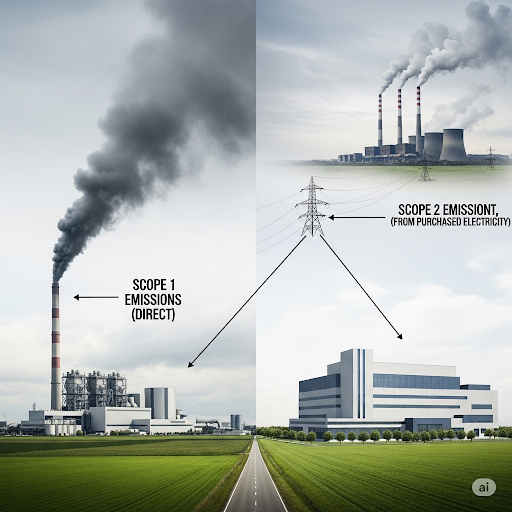
Scope 1 emissions are the direct greenhouse gas (GHG) emissions that arise from sources owned or controlled by the company. In the energy sector, this typically means emissions from burning fossil fuels in power plants, refineries, or company-owned vehicles. It also includes process emissions from chemical reactions, fugitive emissions from equipment leaks, and even emissions from company-owned agricultural operations .
Examples:
- A coal-fired power plant’s smokestack emissions.
- Methane leaks from a natural gas pipeline.
- Diesel burned in a utility’s service fleet.
These emissions are under the company’s direct control, making them the first and often most visible target for reduction efforts .
Scope 2: The Emissions You Buy
Scope 2 emissions are indirect GHG emissions associated with the consumption of purchased electricity, steam, heat, or cooling. While these emissions physically occur at the facility where the energy is generated, they are attributed to the company that consumes the energy .
Examples:
- A utility’s office buildings powered by grid electricity.
- Purchased steam used in industrial processes.
- Cooling supplied by a district energy system.
Scope 2 emissions are significant because they often represent a large portion of a company’s carbon footprint—sometimes even exceeding Scope 1 emissions, especially in sectors with high electricity consumption .
The Key Difference
The primary distinction is control and ownership: Scope 1 emissions are from sources the company owns or controls directly, while Scope 2 emissions are from the company’s consumption of energy generated elsewhere . Both are critical for a complete picture of a company’s climate impact.
Why the Distinction Matters: Strategic and Financial Implications
Regulatory Compliance and Risk
Energy companies face a growing web of regulations requiring the measurement, reporting, and reduction of both Scope 1 and Scope 2 emissions. The Greenhouse Gas Protocol, developed by the World Resources Institute and the World Business Council for Sustainable Development, is the global standard for GHG accounting and reporting . In the European Union, the Corporate Sustainability Reporting Directive (CSRD) mandates comprehensive disclosure of these emissions . In the United States, the EPA provides detailed guidance and expects transparent, accurate inventories .
Non-compliance can result in fines, legal action, and reputational damage. As carbon pricing and emissions trading schemes proliferate, companies with higher emissions face increased operational costs and financial risk .
Investor Expectations and Access to Capital
Investors are increasingly scrutinizing companies’ carbon footprints. Those with lower Scope 1 and Scope 2 emissions are often viewed as less risky and more sustainable, leading to better access to capital and potentially lower borrowing costs. Carbon efficiency is now linked to market valuation and financial performance .
Operational Efficiency and Cost Savings
Reducing Scope 1 emissions often means improving operational efficiency—upgrading equipment, optimizing processes, or switching fuels. Reducing Scope 2 emissions typically involves purchasing renewable energy, investing in energy efficiency, or entering into power purchase agreements (PPAs). Both strategies can lead to significant cost savings and improved profitability .
Risk Management
Effective management of Scope 1 and Scope 2 emissions reduces exposure to volatile energy prices, future carbon taxes, and supply chain disruptions. It also positions companies to respond to evolving regulations and market expectations .
The Numbers: Comparative Impact in Energy Subsectors
The relative impact of Scope 1 and Scope 2 emissions varies across the energy sector:
- Electricity Generation: Scope 1 emissions dominate, especially in fossil-fuel-based generation. For example, coal-fired plants have much higher Scope 1 emissions than natural gas plants .
- Electricity Networks: Scope 2 emissions can be significant, especially when utilities purchase electricity from carbon-intensive grids .
- Gas Utilities: Scope 1 emissions are often driven by methane leaks and venting, while Scope 2 emissions come from electricity used in operations .
In all cases, the carbon intensity of the local grid and the company’s operational practices determine the balance between Scope 1 and Scope 2 emissions .
Case Studies: Leading the Way in Emissions Management
Google: Tackling Scope 2 with 24/7 Carbon-Free Energy
Google has committed to operating on 24/7 carbon-free energy in all its data centers and campuses by 2030. This ambitious goal targets Scope 2 emissions by investing in renewable energy, energy storage, and grid innovation. Google’s approach demonstrates how companies can use their purchasing power to drive systemic change in the energy sector .
Unilever: 100% Renewable Grid Electricity
Unilever achieved its goal of sourcing 100% renewable grid electricity ahead of its 2020 target, slashing its Scope 2 emissions. The company used a mix of PPAs, green tariffs, and on-site generation, providing a blueprint for energy companies seeking to decarbonize their own operations .
BT Group: Electrifying the Fleet
BT Group reduced its Scope 1 emissions by transitioning its vehicle fleet to electric alternatives. For energy companies with large transportation operations, electrification offers a direct path to Scope 1 reduction .
Interface: Energy Efficiency and Renewables
Interface, a modular carpet company, invested heavily in energy efficiency and renewable energy, drastically reducing its Scope 1 emissions. While not an energy company, its strategies are highly relevant for the sector .
Measurement, Reporting, and Verification: Best Practices
Embracing Technology
The energy sector is adopting advanced technologies for emissions monitoring, such as continuous emissions monitoring systems (CEMS) and AI-enabled optical gas imaging (AI-OGI). These tools provide real-time, accurate data, enhancing the reliability of emissions inventories .
International Standards and Collaboration
Aligning with international frameworks, such as the GHG Protocol and emerging global MMRV (measurement, monitoring, reporting, and verification) standards, ensures consistency and comparability. The U.S. Department of Energy and other bodies are working to harmonize reporting practices across the supply chain .
Comprehensive Monitoring
Combining continuous and scheduled monitoring methods—using satellites, drones, and on-the-ground sensors—ensures comprehensive coverage and data validity .
Transparency and Stakeholder Engagement
Transparent reporting and stakeholder engagement build trust and ensure compliance. Public disclosure, third-party verification, and regular stakeholder meetings are now best practices .
Regulatory Trends: The March Toward Transparency
Regulatory requirements for Scope 1 and Scope 2 emissions are tightening worldwide. The EU’s CSRD, the U.S. EPA’s guidance, and similar frameworks in Asia and Australia are pushing companies toward more rigorous, transparent, and verified reporting . Third-party verification is increasingly expected, with assurance levels ranging from limited to reasonable, depending on the maturity of the company’s reporting systems .
Emerging trends include mandatory scenario analysis, integration of emissions data into financial disclosures, and the use of digital platforms for real-time reporting.
Financial Implications: The Cost of Carbon
The financial stakes are high. Companies with high Scope 1 and Scope 2 emissions face:
- Higher compliance costs as carbon pricing expands.
- Increased operational costs if they rely on carbon-intensive energy sources.
- Potential loss of market share to more carbon-efficient competitors.
- Greater scrutiny from investors and potential downgrades in credit ratings .
Conversely, companies that proactively manage and reduce their emissions can unlock cost savings, attract investment, and enhance their market valuation.
Emerging Trends: The Road Ahead
Focus on Methane and Fugitive Emissions
Methane, a potent greenhouse gas, is receiving increased attention. Energy companies are investing in better monitoring and reduction strategies for fugitive emissions, especially in gas utilities .
Integration of Renewables
The shift to renewables is accelerating, driven by both regulatory pressure and cost competitiveness. Companies are using PPAs, green tariffs, and on-site generation to reduce Scope 2 emissions .
Digitalization and Data Analytics
AI, big data, and digital twins are transforming emissions measurement and management, enabling real-time optimization and predictive maintenance .
Carbon Markets and Offsets
Participation in carbon markets and the use of high-quality offsets are becoming standard tools for managing residual emissions, especially where direct reduction is challenging.
What Energy Leaders Must Do: A Strategic Checklist
- Understand Your Emissions Profile: Map out Scope 1 and Scope 2 emissions across all operations and supply chains.
- Set Ambitious, Science-Based Targets: Align reduction goals with international climate commitments and investor expectations.
- Invest in Technology and Efficiency: Upgrade equipment, electrify fleets, and deploy advanced monitoring systems.
- Transition to Renewables: Use PPAs, green tariffs, and on-site generation to decarbonize purchased energy.
- Enhance Reporting and Verification: Adopt international standards, pursue third-party verification, and ensure transparency.
- Engage Stakeholders: Communicate progress to investors, regulators, employees, and the public.
- Prepare for Regulation: Stay ahead of emerging requirements and integrate emissions management into risk and financial planning.
Conclusion: The New Currency of Leadership
In the energy sector, Scope 1 and Scope 2 emissions are more than accounting categories—they are the new currency of leadership, risk management, and value creation. As the world moves inexorably toward a low-carbon future, energy leaders who understand and act on these emissions will not only protect their companies from regulatory and financial risk—they will position themselves at the forefront of the global energy transition.
The journey is complex, but the direction is clear: measure, manage, and reduce. In the race to net zero, every tonne counts—and every leader must know the difference between what they own, what they buy, and what they can change.